
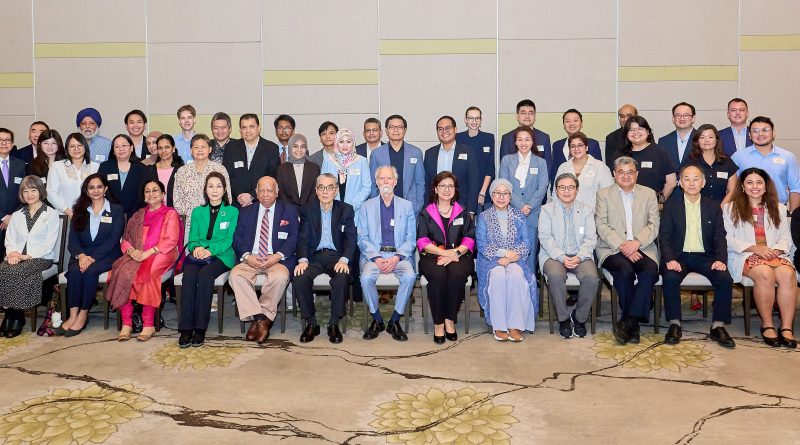
Global Governance Adrift – Pathways Forward for Non-Traditional Security – The 8th NTS-Asia Annual Conference
Themed “Global Governance Adrift – Pathways Forward for Non-Traditional Security,” the 8th NTS-Asia Annual Conference took place from 7 – 8 April. Organised by the Centre for Non-Traditional Security Studies (NTS) at RSIS, the event brought together experts from across Southeast Asia, Northeast Asia and South Asia.
Since 2007, the NTS-Asia Consortium has provided a platform for sustained dialogue on critical NTS issues such as climate and ecological risks, health security, food, energy and water security, human security, and resilience in Asia. The theme for this year’s conference on the state of global governance today is timely, with the international order being contested and challenged, new dimensions of conflicts in the Middle East, the acceleration of artificial intelligence (AI), the urgent need to address the impacts of climate change, and the imperative to protect and steward our natural environment. A video commemorating the milestones of NTS-Asia through the years was also screened.
Professor Barry Buzan, visiting Ngee Ann Kongsi Professor of International Relations at RSIS, and Emeritus Professor of International Relations, The London School of Economics and Political Science, United Kingdom w was keynote speaker for the conference. Professor Buzan spoke on the end of the western world order, how neo-liberalism is in a state of crisis, and the rise of the far right. He then reflected on the implications of these developments on NTS.
Professor Mely Caballero-Anthony, Ngee Ann Kongsi Professor of International Relations and Head of NTS Centre, RSIS; kicked off the conference with welcome remarks. Ambassador Ong Keng Yong, Executive Deputy Chairman, RSIS; then delivered the opening remarks.
The first panel on discussed the state of global governance, its impact on non-traditional security and the role of regional actors and middle powers. Speakers spoke on how global governance is fragmenting and shifting away from rules-based institutions to more interest-driven coalitions. The second panel on energy transition focused on critical minerals, coalitions of climate clubs, and international trade. Following which, the third panel on food security and trade disruptions examined the national and regional approaches to resilience and enhanced food security in ASEAN. The fourth panel on planetary health discussed ecological security and on translating the Planetary Health concept into policy. Panel five looked at the progress of Asia-Pacific states in advancing Women, Peace and Security (WPS) and on how older women have not been considered in digital policy, protection frameworks and WPS. Finally, the last panel investigated the health and biological security risks in the context of global biosecurity, and weaponised supply chains in geopolitics.
As part of the future agenda, participants spoke on ideas on how to develop the consortium’s activities through working groups and developing new, creative ways to increase visibility with platforms such as podcasts and the NTS-Asia website.


