
Publications
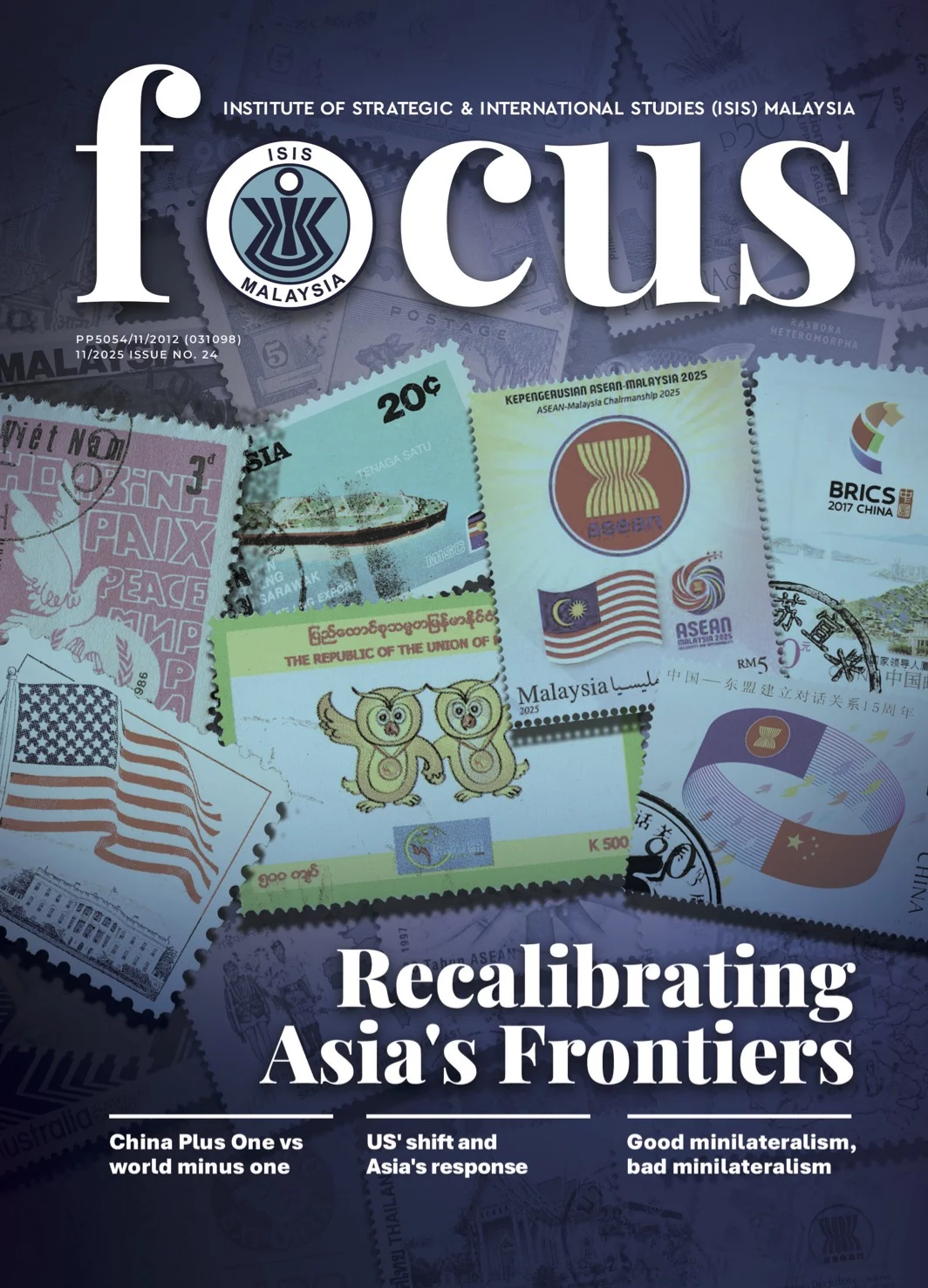
This edition of focus puts forth reflections on key discussions in the 38th Asia-Pacific Roundtable (38APR), the signature international conference of the Institute of Strategic and International Studies (ISIS) Malaysia.
Held from 17–19 June 2025, the 38APR was steered by the theme “Recalibrating Asia’s Frontiers”. The roundtable explored how frontiers in the Asia-Pacific respond to geopolitical and geoeconomic fluctuations within and outside the region.
Over two days, five plenary and two concurrent sessions, role-players initiated discussions on normative and ideological considerations that influence peace, security and conflict in this region, the conceptual boundaries shaping maritime security, Asia’s trade relationships with the wider world and the United States’ role in a changing Asia. To ground the debates in the realities of the region, particular attention was accorded to the Myanmar polycrisis and Southeast Asia’s leadership dynamics.
In his keynote address, Prime Minister Anwar Ibrahim underscored the endurance of ASEAN’s convening power – which could be easy to take for granted and to dismiss as routine summitry – but stressed the need to strengthen regional cooperation beyond rhetoric. Additionally, he asserted Malaysia’s efforts in reaching out to like-minded partners in the Global South and elsewhere to kickstart action-oriented cooperation on all levels.
Central to the pieces in this issue is the deliberation on how nations in the Asia-Pacific negotiate the impact of the United States’ tightening policy and China’s place in the global geoeconomic equation. The first section addresses the strengths and gaps in regional and national systems – namely Southeast Asia, Europe, India, New Zealand and Australia – in their efforts to reckon with contemporary wars and to facilitate peace.
Articles on Myanmar and Thailand ponder upon national crises within ASEAN from a humanitarian and political perspective, respectively. One article reviews the persistent quandary that is the South China Sea and how ASEAN and Track 2 diplomacy can contribute towards a resolution. These are followed by pieces that explore the prospect of minilaterals in recalibrating the global order, the viability of the China Plus One paradigm and the Asia-Pacific’s options in absorbing the pull and push of the US’ increasingly protectionist trade policy.
These articles are written by 38APR role-players and partners, as well as members of the ASEAN-ISIS network.
We are immensely grateful to our contributors, who have generously given some time towards putting their discussions down in writing. Finally, we are indebted to our readers, whose continued support and quality engagement encourage us to keep this publication held to a high standard.