
Publications
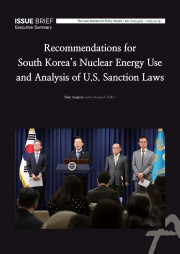
With the release of the Korea–U.S. Joint Fact Sheet on November 14, a new phase of progress in the nuclear field has been opened—namely, pathways toward uranium enrichment and reprocessing, as well as the introduction of nuclear-powered submarines. However, nuclear-powered submarines fall under the category of the “military use” of nuclear energy. It should therefore be noted that certain discussions within the government, particularly those concerning options for the self-procurement of fuel after the expiration of the Korea–U.S. Nuclear Cooperation Agreement, could give rise to situations in which South Korea’s compliance with its non-proliferation obligations, and even its obligations related to the “peaceful use” of nuclear energy, may be called into question.
Even in the case of allied countries, the United States has established a comprehensive legal framework that enables it to impose strong and multi-layered sanctions in response to violations of nuclear non-proliferation principles. These include the Atomic Energy Act of 1954 (AEA), the Arms Export Control Act (AECA), the Foreign Assistance Act of 1961 (FAA), and the International Emergency Economic Powers Act (IEEPA). Under the Atomic Energy Act, all nuclear cooperation can be immediately suspended and the return of U.S.-origin nuclear fuel can be demanded, effectively forcing a shutdown of South Korea’s nuclear power plants. The Arms Export Control Act and the Foreign Assistance Act mandate the termination of all Foreign Military Sales (FMS), military assistance, and economic aid, as well as the blocking of support from international financial institutions such as the IMF. Furthermore, under the International Emergency Economic Powers Act (IEEPA), if the U.S. President declares a “national emergency,” the United States can freeze South Korean government assets within U.S. jurisdiction and completely exclude South Korea from the U.S. financial system, including dollar-based payment networks, thereby paralyzing the national economy as a whole.
The option of enriching and processing U.S.-provided nuclear materials to independently supply fuel for nuclear-powered submarines would constitute a violation of the Korea–U.S. Nuclear Cooperation Agreement even if undertaken after the agreement’s expiration, as it would not qualify as a U.S.-approved “peaceful use” of nuclear energy. As such, it would significantly increase the risk of triggering U.S. sanctions laws. The South Korean government must take this risk seriously and, under the guiding principle of a strict separation between the “peaceful use” and “military use” of nuclear energy, work to complete the relevant domestic and international legal procedures. Uranium enrichment and reprocessing should be addressed as matters related to the “peaceful use” of nuclear energy and discussed strictly within the framework of the Korea–U.S. Nuclear Cooperation Agreement. The introduction of nuclear-powered submarines and the procurement of their fuel, by contrast, must be recognized as matters related to the “military use” of nuclear energy and pursued through separate legal tracks, including consultations with the United States and the International Atomic Energy Agency (IAEA). In this process, publicly disclosing compliance with IAEA safeguards agreements and clearly reaffirming that the denuclearization of North Korea remains a core policy objective would further reinforce South Korea’s commitment to fulfilling its non-proliferation obligations in the international community.