
Publications
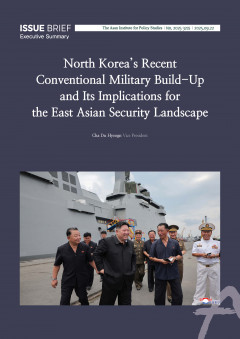
Until recently, discussions of North Korea’s military threat have focused primarily on its nuclear capabilities. Since conducting its first nuclear test in October 2006, North Korea has advanced its nuclear program through six tests and, by the 2020s, has developed tactical nuclear weapons and a variety of delivery systems capable of targeting the Korean Peninsula. However, it is important to note that over the past two to three years, North Korea has also been devoting considerable attention to the modernization of its conventional forces alongside its nuclear arsenal.
In January, 2025, North Korea revealed a tank exercise featuring its new Cheonma-2 model, and in March Kim Jong Un inspected the construction site of a “nuclear-powered strategic guided-missile submarine.” In April and May, North Korea also held launch ceremonies for two new destroyers, the Choe Hyon and Kang Gun (the second of the Choe Hyon class), each displacing roughly 5,500 tons. Whereas in 2021, North Korea’s investments in conventional forces were largely focused on drones, reconnaissance satellites, and other “selection and concentration” for future warfare, these investments have gradually broadened in scope since 2023. That said, it remains uncertain whether North Korea’s new weapons can perform as advertised. The capabilities of its new tanks, submarines, and destroyers have yet to be verified, and the presence of key equipment has not been confirmed. Even with the economic breathing room provided by closer ties with Russia, it is unclear whether North Korea has the resources to operationally deploy these systems. Despite the rapid pace of conventional force build-up, North Korea is unlikely to offset South Korea’s qualitative edge within the next one to two years.
This article is an English Summary of Asan Issue Brief (2025-30).