
Publications
SYNOPSIS
The energy crisis, stemming from the conflict in the Middle East, has once again exposed Southeast Asia’s deep reliance on fossil fuels and the urgency of addressing this reliance. It may yet accelerate the shift towards renewable energy. For now, however, the immediate policy responses of countries in the region, such as the Philippines and Malaysia, focus on alleviating the economic costs of the crisis through fuel subsidies, price controls, and support measures to cushion the pressures on households.
COMMENTARY
The conflict between the US, Israel, and Iran, and the subsequent closure of the Strait of Hormuz have resulted in an energy crisis on a global scale. Among the world’s major regions, the Asia-Pacific is particularly vulnerable to such shocks, given its high dependence on fossil fuels, with Japan, South Korea and ASEAN as major importers of crude oil and LNG from the Middle East. According to the International Energy Agency, around 80 per cent of crude oil and oil products passing through the Strait in 2025 were bound for Asia.
What are the implications of the energy crisis that has unfolded since the conflict began and the Strait of Hormuz was closed? Has it set back energy transition in Southeast Asia, or has it catalysed the region to accelerate its renewable energy ambitions? As the dust settles, Southeast Asia must confront the reality that energy transition is an imperative for national and regional security.
Oil Importers, Oil Producers and Socio-Economic Implications
Despite expectations that oil-producing countries would be more resilient, both oil-producing and oil-importing countries across Southeast Asia have adopted similar short-term measures to stabilise oil supply and pricing.
Oil-importing countries are, expectedly, severely affected. The Philippines declared a national emergency, while in Singapore, small and medium-sized enterprises (SMEs) are facing disruptions and falling revenues. Oil-exporting states have not been spared either. Thailand, for example, has seen factory closures, as rising energy costs bite.
In the case of the Philippines, it is highly vulnerable as it imports about 90 per cent of crude oil from the Middle East and relies on refined oil from other countries such as South Korea, China and Singapore. Rising fuel costs have placed economic pressure on all segments of society, increasing prices of food and consumer goods. In Manila, transport workers went on strike to protest the rising diesel prices, calling for the government to remove taxes on fuel products.
Despite being an oil producer, Malaysia still heavily depends on the Middle East for approximately 70 per cent of its crude oil supply. Supply disruptions have impacted its manufacturing sector, and increased fuel subsidies have been implemented to help regulate consumer costs. The crisis has also spurred the country to accelerate its use of biodiesel in the transport sector, making steady strides toward greater use of renewable energy sources.
In these cases, it is evident that rising oil prices has had a wide-ranging impact on the economy, livelihoods and the cause of cascading political implications. Reliance on fossil fuels makes states vulnerable to price shocks and threatens national security – that is why governments must recognise that investing in and growing the renewable energy industry is a key strategy for building energy security resilience in the face of conflicts and global uncertainty.
Short-Term Responses: Diplomacy, Diversification and Geopolitics
To cope with the disruptions, countries have sought alternatives to meet the shortfall. The Philippines and Malaysia have engaged in diplomatic efforts to secure their oil supply from other sources. The Philippines, for example, has sought exemptions from the US that would allow it to import oil from US-sanctioned countries such as Russia. As for Malaysia, it has been active diplomatically in diversifying its oil and gas supply, securing imports from Iran, Russia and Brazil.
However, while effective as a short-term solution, these efforts are insufficient to strengthen long-term energy resilience, as reliance on fossil fuel imports makes energy security vulnerable to geopolitical tensions and shifting national priorities.
Furthermore, the recasting of energy flows may place importing countries in a political bind, where they may be pressured to comply with the demands of energy exporters. Although the US lifted sanctions on Russian oil as a temporary measure, in the long run, states buying Russian oil may face diplomatic pushback from the US and the European Union. Ultimately, Southeast Asian countries need to develop their domestic renewable energy capacity while strengthening regional energy cooperation.
Long-term Priorities: Reducing Dependence on Fossil Fuels
The closure of the Strait of Hormuz has demonstrated that Southeast Asia as a region still has a long way to go in developing its renewable energy sector. The responses of both the Philippines and Malaysia to the energy crisis indicate that the real short-term priorities hinge on securing fossil fuel supplies in tackling shortages.
While the transportation sector was the hardest hit by the rising cost of energy, electricity generation in the region has also been disrupted. One of the long-standing challenges Southeast Asia faces is its coal consumption. During times of fuel shortage, countries in the region have fallen back on coal as a substitute for oil and liquefied natural gas (LNG) to meet their energy demands. This has caused a temporary setback to efforts by states, such as the Philippines, which had previously reduced coal-fired power from 61.9 per cent in 2024 to 57.2 per cent in 2025, while increasing LNG’s share of its energy mix.
In response to rising oil and LNG costs, countries such as the Philippines, Thailand and Indonesia increased coal generation. Fossil fuels, namely coal, oil, and natural gas, have made up 80 per cent of the region’s energy demand, and while the renewable energy share is expected to grow, fossil fuel use is also likely to rise.
Retaining the Momentum for Renewable Energy Development
Although the region cannot eradicate fossil fuel consumption in the near term, countries must not lose momentum on renewable energy development. The transition offers economic dividends in terms of employment, investment, and cleaner energy. Furthermore, it will strengthen national energy security by reducing dependence on imported fuels.
Fortunately, progress in the energy transition has not been derailed. The Philippines, for example, has announced that it will accelerate its grid integration, which consists of 22 renewable energy projects. Malaysia has similarly set ambitious goals as part of its national energy transition roadmap. On-the-ground demand for portable solar generators and electric vehicles has also increased in Malaysia. These signal growing domestic appetite for renewable energy adoption.
Alongside national strategies, accelerating the ASEAN power grid is a key part of the regional architecture that will help member states strengthen renewable energy trade, overcome energy intermittency, and enhance access to energy. Barriers to the growth of the renewable energy sector include lack of private-sector investment, a skilled workforce, and regional interconnections. These are areas that must be addressed.
About the Author
Danielle Lynn Goh is an Associate Research Fellow with the Centre for Non-Traditional Security Studies at the S. Rajaratnam School of International Studies (RSIS), Nanyang Technological University, Singapore.
Executive Summary
The global energy landscape is increasingly unstable, shaping vulnerabilities linked with external energy dependence. At the same time, energy demand in Southeast Asia continues to rise at a high pace. These effects increase the urgency for ASEAN to accelerate measures that strengthen its energy security anchored in regional resilience. To enhance the region’s energy future, ASEAN could adopt a strategy that incorporates a planetary health perspective converging ecological stability, public health and human security. This involves relying on advancing the ASEAN Power Grid, while leveraging its critical mineral resources to enhance green partnerships and developing supportive clean measures, including nuclear energy. Each approach comes with a clear responsibility to mitigate potential risks to ecosystems and community well-being. This proposed integration of a planetary health perspective ensures that Southeast Asia’s energy solutions do not undermine the people and systems that the energy transition ultimately seeks to protect.
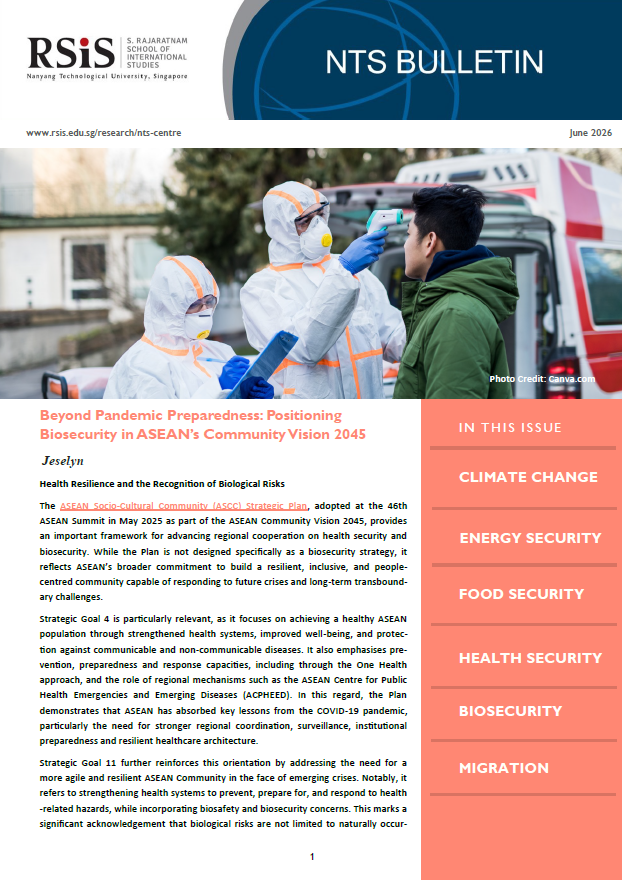
Health Resilience and the Recognition of Biological Risks
The ASEAN Socio-Cultural Community (ASCC) Strategic Plan, adopted at the 46th ASEAN Summit in May 2025 as part of the ASEAN Community Vision 2045, provides an important framework for advancing regional cooperation on health security and biosecurity. While the Plan is not designed specifically as a biosecurity strategy, it reflects ASEAN’s broader commitment to build a resilient, inclusive, and people-centred community capable of responding to future crises and long-term transboundary challenges.
Strategic Goal 4 is particularly relevant, as it focuses on achieving a healthy ASEAN population through strengthened health systems, improved well-being, and protection against communicable and non-communicable diseases. It also emphasises prevention, preparedness and response capacities, including through the One Health approach, and the role of regional mechanisms such as the ASEAN Centre for Public Health Emergencies and Emerging Diseases (ACPHEED). In this regard, the Plan demonstrates that ASEAN has absorbed key lessons from the COVID-19 pandemic, particularly the need for stronger regional coordination, surveillance, institutional preparedness and resilient healthcare architecture.
Strategic Goal 11 further reinforces this orientation by addressing the need for a more agile and resilient ASEAN Community in the face of emerging crises. Notably, it refers to strengthening health systems to prevent, prepare for, and respond to health-related hazards, while incorporating biosafety and biosecurity concerns. This marks a significant acknowledgement that biological risks are not limited to naturally occurring disease outbreaks, but also include broader concerns relating to safety, security, and preparedness in the management of biological hazards.
These provisions represent a positive development. They locate biosecurity within ASEAN’s wider socio-cultural agenda and recognise that biological risks have implications beyond the health sector alone.
BIPSS Research Associate Mohosina Mostofa Mity explores in this commentary how the global surge in defence spending is placing growing financial pressure on smaller economies. The commentary examines the difficult trade-offs between strengthening national security and sustaining investments in development, while arguing that long-term resilience depends on smart strategic choices rather than simply larger military budgets. It highlights why balancing defence, economic stability, and human development will be one of the defining policy challenges of the coming decade.
SYNOPSIS
An unstable global energy landscape is a wake-up call for Southeast Asia’s energy security and transition efforts. Integrating ecological, health, and security concerns into solutions centred on the ASEAN Power Grid, as well as the sustainable management of critical minerals, can build resilience while safeguarding the planetary health the region seeks to protect.
COMMENTARY
Conflicts in the Middle East have exposed vulnerabilities linked to dependence on imported fossil fuels. This severe energy crisis reinforces the case for accelerating Southeast Asia’s energy transition. Amid a fracturing global landscape, striving for regional resilience is crucial to reducing reliance on external resources and adapting to a decarbonised future.
Yet enhanced commitments to the energy transition also require critical engagement with its ends and means – integrating both technical solutions and the systems thinking of a Planetary Health perspective. The transition calls for the convergence of ecological stability, public health, and human security. This makes the region’s aspirations for energy security inextricably linked to the preservation of human and environmental well-being.
The Cog in the Wheel: External Energy Reliance
The global momentum of the energy transition has been affected by the recalibration of US foreign policy, creating overlapping pressures on Southeast Asia’s path to energy resilience. Disruptions to vital energy supply chains caused by the Iran war have sparked swift energy shortages and price hikes across parts of Southeast Asia, prompting the Philippines to declare a state of national energy emergency.
Simultaneously, the US disengagement from the Just Energy Transition Partnerships (JETP) – the multilateral financial mechanisms designed to mobilise blended public-and-private finance to accelerate early coal-plant retirements and the integration of renewables – removes crucial financial architecture.
What is lost extends far beyond abstract capital, as it deprives energy transition frontrunners like Indonesia and Vietnam of critical low-cost, de-risking grants and concessional loans necessary for early coal phase-outs. Compounding this, the closure of USAID initiatives strips the region of critical technical assistance for grid modernisation.
Southeast Asia has also been affected by the export of carbon-intensive practices to the region. Facing substantial economic pressure from sweeping US tariffs, regional governments have prioritised immediate economic relief over long-term environmental health by signing long-term agreements for US liquefied natural gas (LNG) and oil. These import agreements represent generational infrastructure commitments, locking states into fossil-fuel dependence until the mid-2040s.
This triple impact leaves Southeast Asia in a precarious position, where reverting to environmentally damaging energy sources becomes the path of least resistance. Amid fossil fuel lock-ins and, most recently, a surge in coal production, immediate energy needs have taken precedence over decarbonisation commitments. Delaying the displacement of coal and gas locks the region into prolonged fossil fuel combustion, directly worsening localised air pollution and the burden of respiratory diseases. It also accelerates climate-induced disasters that undermine regional ecological resilience – profound planetary health consequences that compound over time.
The wider lesson for Southeast Asia is the vulnerability that arises when energy security and transition pathways are linked to external parties. Thus, while an enhanced energy partnership with China may offer a partial solution to the immediate crisis, this may ultimately expose the region to similar external shocks and asymmetric dependencies. Hence, the answer lies within the region itself.
The ASEAN Power Grid: A Planetary Health Paradigm
The unstable global energy landscape highlights the urgent need for Southeast Asia to strengthen regional interconnection and accelerate its transition to clean energy. This approach is a viable strategy that enhances energy security by reducing vulnerabilities linked to external crises and opens pathways towards meaningful progress on decarbonisation.
At the same time, energy transition strategies must now explicitly protect the region’s environmental integrity. Clean energy advances are vital to the region’s future, but they must not come at the cost of local ecosystems or community well-being. In other words, the pursuit of decarbonisation cannot justify the degradation of the very planetary health it seeks to protect.
ASEAN’s strategy for enhanced energy resilience requires engagement with key transition initiatives that protect ecological and community integrity. At the heart of the approach lies the ASEAN Power Grid (APG), a regional mechanism capable of building energy security while accelerating the transition to a cleaner energy mix. Targeting a fully interconnected power system by 2045, the APG enables more affordable energy access through cross-border electricity flows that reduce dependence on uneven national capacities and external supply.
Importantly, the APG has the capacity to integrate the region’s vast untapped renewable energy potential. Improved connectivity would facilitate significant gains in wind, solar and hydropower generation. By optimising the distribution of these transboundary clean energy sources, the APG can mitigate localised air pollution and climate-induced health risks associated with non-renewable sources.
Recent progress, such as the establishment of the ASEAN Power Grid Financing Initiative – aimed at mobilising large-scale public and private financing – must be reinforced by reducing investment risks and harmonising regulations. Equally important is a careful assessment of the environmental and community impacts of large-scale infrastructure development to minimise harm.
The Material Paradox of Regional Interconnection
A comprehensive systems perspective, however, reveals that the physical realisation of the APG cannot be decoupled from the broader ecological and material realities of resource extraction.
Southeast Asia holds vast reserves of critical minerals essential for manufacturing the technologies that power the regional grid. These include nickel, tin, and rare earth elements (REEs). Yet, because these resources frequently overlap with vital biodiversity hotspots and indigenous lands, extraction imposes profound costs on planetary health, directly threatening the region’s biophysical stability – the state of ecological regulatory systems required to sustain human wellbeing.
The geopolitical race to secure critical minerals poses severe ecological risks, as research into the environmental destruction linked to rare earth mining has shown. Extracting REEs generates massive volumes of toxic and radioactive waste.
These crises are already unfolding across Southeast Asia, with vital waterways contaminated by toxic chemicals, spreading illness and causing unidentified tumours in marine life that fishing communities depend on for survival. Furthermore, rapid expansion of nickel mining has driven extensive deforestation, increasing localised vulnerabilities to landslides and floods.
If the expansion of the APG relies on a path of unchecked material extraction that destroys local ecosystems, disrupts livelihoods, and poisons community water supplies, the transition will fail the systems test of a Planetary Health approach and trade one set of energy crises for another.
The pursuit of a regional grid must therefore not be treated purely as an engineering or market-integration goal. Instead, it must explicitly integrate the protection of terrestrial ecosystems and the well-being of local populations against the systemic and often irreversible harms of extraction.
Building Regional Resilience
Importantly, the fracturing global landscape can trigger a dangerous “race to the bottom” that must be avoided. The Iran war demonstrates that reliance on external guarantors for climate progress is an untenable strategy. While attaining full regional self-sufficiency is a difficult target, gradual advancements in this direction through a greater focus on its own renewable energy resources would support ASEAN’s dual goals of building energy security and reducing fossil fuel dependence.
Fortunately, increased global demand for critical minerals strengthens ASEAN’s bargaining position. To succeed, ASEAN must implement stringent regulatory oversight to avoid environmentally damaging lock-ins or worsening health risks from the destruction of its ecological systems.
Future agreements with international partners must mandate clean technology transfer and ensure strict adherence to sustainable mining standards – conditions that enable ASEAN to leverage its mineral wealth while mitigating planetary health risks. This steers capital towards genuinely sustainable development and energy resilience while avoiding over-reliance on any single energy source or partner.
A unified commitment to the ASEAN Power Grid is essential for leveraging intra-regional renewable energy potential. At the same time, critical mineral wealth must be managed as a strategic lever for sustainable development, not merely as an export commodity.
Ultimately, the region’s success in managing ongoing and future energy crises will be measured, not only by its resilience to external shocks, but also by the preservation of its planetary health. ASEAN has the potential to pioneer a model of resilience that safeguards both its populations and ecological foundations. This requires charting a deliberate course where energy security and planetary health goals should be considered in an interconnected manner.
About the Authors
Adam X. Hansen and Pey Peili are, respectively, Research Analyst and Research Fellow at the Centre for Non-Traditional Security Studies (NTS Centre), S. Rajaratnam School of International Studies (RSIS), Nanyang Technological University (NTU), Singapore. Pey leads the NTS Centre’s Planetary Health programme
SYNOPSIS
Timor-Leste’s recent entry into ASEAN offers a new opportunity to strengthen regional food security by offering a glimpse of alternative models for food resilience, especially amid ongoing disruptions to chemical fertiliser supplies stemming from the conflict in the Middle East.
COMMENTARY
Disruptions to chemical fertiliser supplies amid Middle East tensions have intensified calls across Southeast Asia for a transition toward organic alternatives. This remains very much an ambition for the ASEAN region, which has an organic coverage of less than 0.5 per cent of its total agricultural land and less than 1 per cent of its arable land, according to UN Food and Agriculture Organisation (FAO) statistics.
Timor-Leste, ASEAN’s newest member, offers a striking contrast, where organic fertiliser use already covers 9.2 per cent of its total agricultural area and 28 per cent of its arable land. Could the country, despite its lower per capita income, serve as a model for bottom-up societal resilience amidst ongoing disruptions to chemical fertiliser supplies?
Organic by Default
Timor-Leste’s higher use of organic fertilisers was not by design but by necessity. It resulted from the country’s limited access to chemical fertilisers, due to economic constraints. According to IMF statistics, its GDP per capita is approximately USD 1,500 annually, comparable to Myanmar’s. This places it among the lowest-income countries in ASEAN.
The country likewise holds limited currency reserves – with a current account deficit of close to USD 700 million, mostly due to importing more than it exports, which amounts to 32 per cent of its GDP. Its government also has limited fiscal capacity to support its farmers, and is reliant on external support, with net borrowing amounting to more than half of its GDP.
Given such constraints, over 18 per cent of its population was undernourished in 2022-24, more than triple the average level in ASEAN of approximately 5 per cent. This figure also corresponds to the poverty rate, with 16 per cent of the population living below the poverty line and unable to afford the food needed for healthy and active lifestyles.
Bottom-Up Community Resilience: Timor-Leste’s Coffee Story
These challenges, however, do not preclude the country from serving as a role model for other ASEAN countries in organic farming. Behind what appears to be underdevelopment lie indigenous sources of resilience most clearly observable in its coffee sector. Notably, this resilience is rooted in cooperative, non-market mechanisms that work alongside, rather than against, market mechanisms, for instance, through the community-organised Cooperative Café Timor (CCT, or Timor-Leste Coffee Cooperative).
While Timor-Leste is primarily a petrostate exporting crude oil and natural gas, its largest non-oil export is coffee. Unlike normal trade where coffee is left to volatile market prices, the CCT in Timor-Leste, formed in 2000, instead provides farmers with guaranteed coffee prices that are 40 per cent above market prices. Such benefits are enabled by the Fairtrade Network of Asia and Pacific Producers (FNAPP), which is exclusive to developing countries and to which the CCT is a party. The cooperative likewise provides farmers with the inputs for their production as well as extension services such as training in implementing good agricultural practices (GAP) in organic farming.
Beyond these, the CCT also draws broad societal benefits from the FairTrade revenues by hosting a string of seven “Clinik Café Timor” clinics that provide free health services to smallholder families. These clinics, supported in part by the Timor-Leste Ministry of Health, treated more than 11,000 patients a month during the COVID-19 pandemic.
Timor-Leste’s experience suggests a broader, counterintuitive insight that countries too poor to industrialise their agricultural sectors may now hold a structural advantage. Free from high chemical dependence in their food systems and supported by grassroots, community-governed supply chains, they offer a model of resilience that wealthier economies are now trying to replicate amid increasing global supply chain instability. This model is not without precedent. India’s Amul cooperative was formed in 1946 to eliminate the exploitation of farmers and returns 85 per cent of earnings to its 3.6 million farmer-members. The CCT model thus holds significant potential for replication across the region.
Forward-Looking Challenges Amidst Climate Change
As many farms in Timor-Leste are organic, coffee is primarily cultivated under native shade trees. These trees buffer plants from extreme weather and reduce temperatures, which in turn limits conditions that favour pests and diseases, thereby providing a form of natural pest resilience.
The most common variety, Hibrido de Timor (HdT), is a naturally occurring hybrid of arabica and robusta that is heat-tolerant and can be grown in warmer, low-altitude areas. HdT also has higher resistance to fungal diseases such as coffee leaf rust and pests such as coffee berry borers, a destructive beetle species.
Climate change poses a growing threat to HdT’s resilience and to coffee production in Timor-Leste more broadly. Warmer and more humid conditions increase the risk of coffee berry borers and coffee leaf rust. At the same time, heat stress can reduce yields and bean quality over time, even for a highly resilient variety like HdT, especially without additional climate adaptation measures.
The frequency and intensity of droughts and heavy rain are projected to increase, further disrupting production. These challenges are further compounded by ageing coffee trees and limited agronomic knowledge among smallholder farmers. Declining yields could threaten rural livelihoods and Timor-Leste’s position in the speciality coffee market, especially since coffee is an important source of income for approximately 27.5 per cent of households.
Addressing these climate risks will require coordinated adaptation, with CCT central to this effort. Cooperative membership is positively associated with climate-smart agriculture (CSA) adoption, as cooperatives provide platforms for knowledge sharing, technical support and peer learning. CCT could scale up training in climate-smart practices, facilitate replanting of ageing trees and distribute early pest-warning information to members. It could also partner with universities to further improve the HDT variety’s resistance to future environmental stressors. These measures could help smallholders absorb climate shocks while protecting Timor-Leste’s standing as the origin of speciality coffee.
A Dual Track Path for Timor-Leste’s Agricultural Development
Timor-Leste, which joined ASEAN in 2025, is well-positioned to catch up, with 64 per cent of its population under 30. Among the first beneficiaries of integration into the ASEAN Free Trade Area (AFTA) will likely be Timor-Leste’s agricultural sector, which is a key source for jobs and food security for 52 per cent of its population and 63 per cent of poorer households.
A critical question today is whether the CCT model will eventually be replaced by market-driven trade within AFTA. On the one hand, the 4.5 per cent annual increase in ASEAN’s regional trade from 2010 to 2019 has coincided with a significant reduction in poverty, from 19 per cent in 2010 to less than 14 per cent in 2019. Yet, the growing instability in global fertiliser, oil and food supply chains in the 2020s reveals the limits of purely laissez-faire approaches.
The question should thus be how to step up Timor-Leste’s CCT as an alternative model that prioritises farmers’ lives and livelihoods through cooperative-based institutions within market-based mechanisms. Economic liberalisation does not require dismantling cooperative infrastructure, as was the case in India’s Amul cooperative. Crucially, scaling up such approaches today implies extending the FairTrade approach beyond coffee to other agricultural exports, such as vanilla, coconuts, and candlenuts.
Towards a More Resilient ASEAN Food System
Timor-Leste’s entry into ASEAN offers a glimpse into what is possible for ASEAN’s food security framework amid the dual pressures of supply chain fragility and the uneven gains of regional trade integration. Despite its current economic constraints, it presents an opportunity to build agricultural resilience without relying heavily on chemical inputs, especially as more developed ASEAN economies increasingly face the vulnerabilities of input-dependent agriculture.
The CCT model could inform broader regional frameworks for cooperative-based food security in ASEAN, not as a replacement for free-market trade, but as its evolution towards a regional architecture that treats community-governed supply chains as strategic assets. Far too often, such traditional, indigenous innovations are seen as signs of backwardness or symptoms of underdevelopment; yet Timor-Leste’s experience during COVID-19 proved that such mechanisms can serve as societal anchors amidst turbulent currents of change.
At the regional level, ASEAN could incorporate elements of the CCT model into its broader food security architecture by creating novel “FairTrade pacts” in collaboration with its Plus Six Partners. Australia and New Zealand, as key players in the FairTrade movement, could share their expertise to strengthen local procurement networks and support sustainable agricultural practices. Such measures would complement existing efforts to enhance regional food resilience while reducing dependence on volatile global input and commodity markets.
It would be wise and timely to capitalise on what Timor-Leste’s ascension offers – a chance to strengthen ASEAN’s food system, taking a step back to take two steps forward.
About the Authors
Jose Ma. Luis Montesclaros is a Research Fellow and Lead of the Food Security (FS) Programme at the Centre for Non-Traditional Security Studies (NTS Centre), S. Rajaratnam School of International Studies (RSIS), Nanyang Technological University (NTU), Singapore. Kayven Tan is a Senior Analyst with the NTS Centre’s FS Programme.
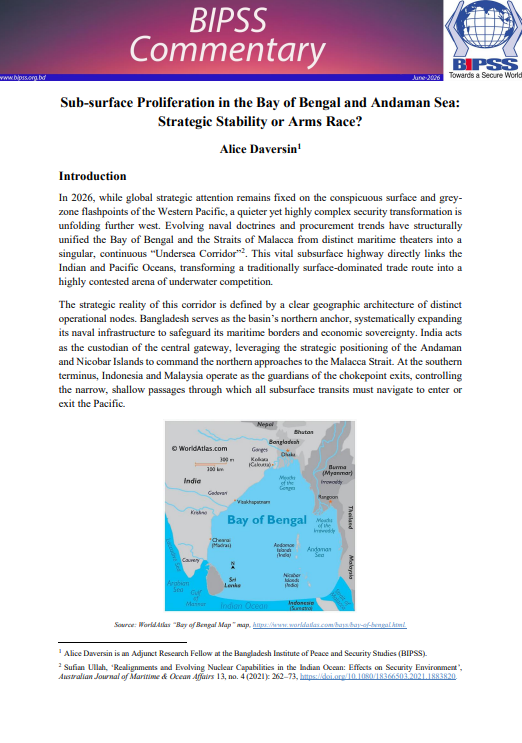
BIPSS Research Fellow Alice Daversin explores the growing but often overlooked sub-surface competition in the Bay of Bengal and the Andaman Sea, arguing that the region is evolving into a strategic “Undersea Corridor” linking the Indian and Pacific Oceans. The study highlights how expanding submarine capabilities, hydro-oceanographic mapping, and acoustic intelligence gathering are reshaping regional security dynamics. It warns that the absence of transparency and confidence-building mechanisms risks transforming defensive modernization into an unmanaged arms race. The paper calls for stronger multilateral cooperation to prevent accidental escalation and preserve strategic stability in one of the world’s most vital maritime corridors.
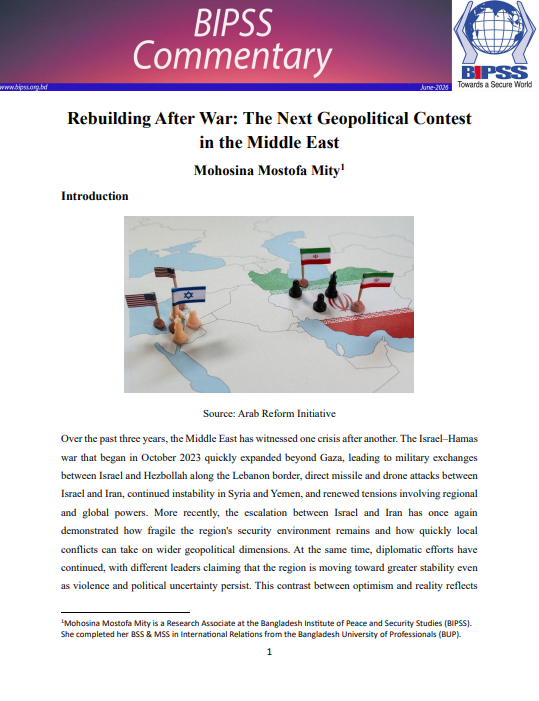
BIPSS Research Associate Mohosina Mostofa Mity argues in this piece that post-war reconstruction in the Middle East has become a new arena of geopolitical competition, where global and regional powers use funding, infrastructure, and energy corridors to shape political influence and long-term alignments beyond the battlefield. She highlights how “conditional reconstruction,” early recovery financing, and competing models of Western institutional support and Chinese connectivity initiatives are reshaping governance, sovereignty, and development choices in conflict-affected states. The commentary concludes that rebuilding the region is no longer just about restoring infrastructure, but about determining the future political and strategic order of the Middle East.
This strategic analysis from BIPSS, authored by Alice Daversin, examines the critical inflection point of the ongoing conflict in Iran. The report breaks down the shift toward unrestricted energy warfare, the physical mining of the Strait of Hormuz, and targeted US-Israeli strikes aimed at dismantling the regime’s infrastructure. It also explores the resulting global economic shocks, disrupted Gulf oil supplies, and the unique geopolitical exemptions granted to Bangladesh.