RCSS Researcher Chamika Wijesuriya says Cyclone Ditwah revealed the consequences of unresolved land, labour rights and administrative marginalisation of the Malaiyaha Tamil community
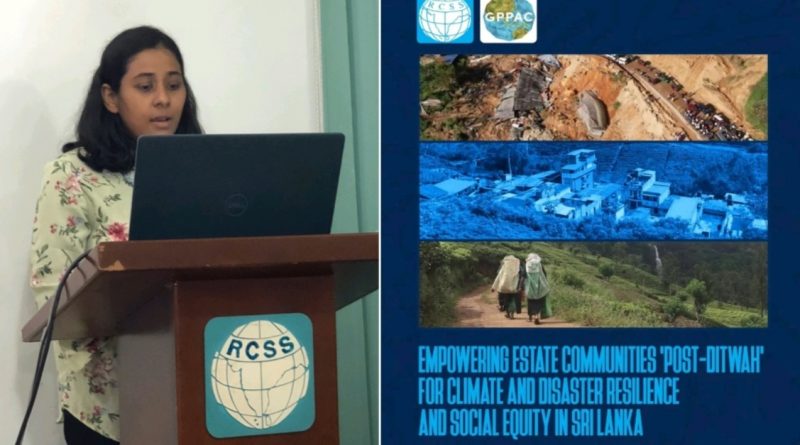
Chamika Wijesuriya, Research/ Programme Officer, Regional Centre for Strategic Studies (RCSS) has observed that while “Cyclone Ditwah did not create the vulnerability of the Malaiyaha Tamil community, it revealed the consequences of unresolved land and labour rights and administrative marginalisation within the plantation regions, primarily driven by structural and institutional factors rather than by disaster events alone”.
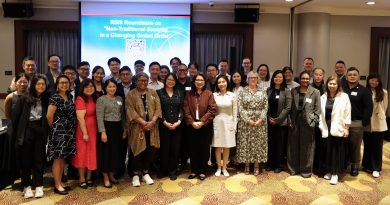
Wijesuriya made these observations following a recent focus group study conducted with women, youth, elderly and community leaders of Upcot, Nuwara Eliya, who were affected by cyclone Ditwah. Titled ‘Empowering Estate Communities ‘Post-Ditwah’ for Climate and Disaster Resilience and Social Equity in Sri Lanka’, the study published by the RCSS as a Sri Lankan contribution to the Climate, Peace and Security (CLIMPSE) Project of the Global Partnership for the Prevention of Armed Conflict (GPPAC), was launched at a Multistakeholder Forum held at the RCSS on 5 June 2026.
The study revealed a critical gap between disaster management and the lived realities of communities within estates of Sri Lanka, underserved by state services like education and health care, and which remain entrenched in outdated labour practices that are detrimental to people’s health and status. It cautioned that as climate change intensifies in 2026, these communities face acute water insecurity and disaster risk. It advocated for a ‘Recognitional Equity Framework’ that integrates traditional grassroots knowledge into national climate policy, whilst empowering communities residing in estates by addressing structural inequalities. It argued that climate action can be a catalyst for national integration of Malaiyaha Tamil communities through the inclusion of community knowledge regarding the land into development and relocation schemes. Simultaneously, communities need to be provided with land and housing rights in geographies they have inhabited for centuries, with improved infrastructure and services, and also need empowerment in technical and scientific knowledge to restore the resiliency of their ecosystems, practice sustainable farming and animal husbandry, and make their housing resilient to climate change.