
‘ ’
Ambassador (Retd.) Esala Weerakoon has observed that “it is time for us to consider a ‘South Asian Climate Compact’—a renewed, collective commitment to safeguard our environment, protect our people, and uphold climate justice. Such a compact would reflect our shared vulnerabilities, our shared responsibilities, and our shared aspirations”.
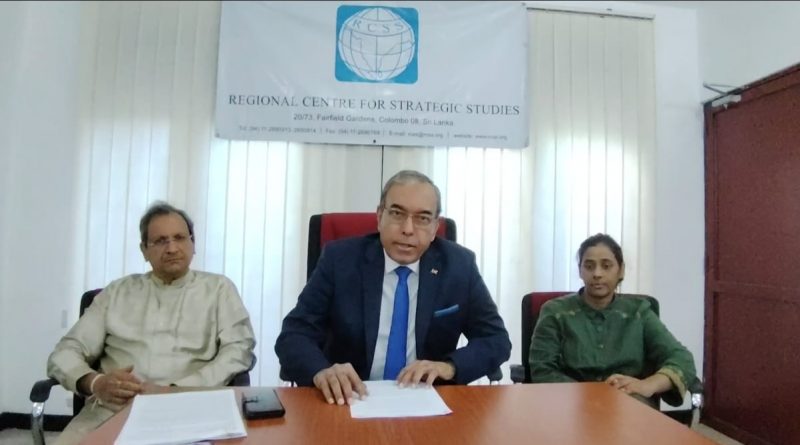
Ambassador Weerakoon, a former – Secretary General of the South Asian Association for Regional Cooperation (SAARC) and Foreign Secretary of Sri Lanka made this observation when he delivered Valedictory Remarks from the Regional Centre for Strategic Studies (RCSS) in Colombo, at the conclusion of the 9 day zoom based ‘The Southasia Lectures’ (SAL) series on the theme “Climate Policy and Climate Justice” which featured experts presenting the status of climate mitigation and adaptation in their respective country. An overview of the overall South Asian situation was held on the last day, 8 December 2025 – which fell on ‘SAARC Charter Day’ – the 40th Anniversary of the adoption of the SAARC Charter. The series was curated by Dr. Swarna Rajagopalan of Chiaitanya, the RCSS, with Himal Southasian and Sansristi, as outreach partners.
Ambassador Weerakoon observed that “While it is a day of pride, it is also a day to reflect on the journey of SAARC, the achievements made and the challenges faced. It is also a meaningful occasion, to reflect on our shared regional identity and the collective future we must shape together. Noting that “climate change was not merely an environmental issue—it is a human issue, a justice issue, and ultimately a regional peace and security issue”, he said “the future of South Asia depends on our ability to act together, to imagine boldly, and to uphold the principles of solidarity that define our region. Amb. Weerakoon emphasised the continuing relevance of SAARC as “South Asia depends on our ability to act together, to imagine boldly, and to uphold the principles of solidarity that define our region”. He said, “SAARC must continue to strengthen its institutions and ensure that its activities yield tangible benefits for the people of South Asia.”
Dr. Rajagopalan addressing the concluding session said the series was intended to create a learning opportunity for fellow Southasians to learn about each other. As a part of RCSS’s alumni community she was also sensitive to the need for greater connectivity among Southasians. It was noted that the series fostered holistic learning among Southasians, about the intersectional impacts of climate change, on gender, livelihoods, community, ecology, governance, economy and politics. The speakers highlighted local and regional challenges, especially transboundary impacts of disasters, water and food insecurity due to depleting resources, and widespread health impacts. Also recognised was the need for knowledge sharing, advocating for a “borderless conversation”, sharing success stories, and presenting a united front at global forums like COP.
The RCSS Coordinator for the series, Ms. Chamika Wijesuriya, pressed the need for community empowerment at the intersections of climate mitigation, adaptation and disaster risk reduction. “Giving the community the necessary knowledge, skills and equipment can help them strengthen their homes and livelihoods”. She also impressed that just, equitable solutions, strong policy interventions and regional alliances with knowledge and technology transfer are the needs of the hour, and should be a key focus areas of mitigation and adaptation.
Executive Director of RCSS Amb (Retd.) Ravinatha Aryasinha in closing comments reiterated the importance of this collective effort, taking place at a time Southasians are witnessing – as Sri Lankans did last week, impacts of cataclysmic disasters, and ecosystem collapse in real time, with people losing their lives, livelihoods and on property. Appreciating the support Sri Lanka received particularly from countries within the region, he stressed the need for regional cooperation within the ‘Global South’ for more long term solutions, given that ‘multilateralism’ was failing to deliver redress. Referring to SAARC, he observed that the evaluation of its success must be assessed not as a snapshot but over the longue durée, and also whether one sees its purpose as having been to serve as a ‘engine’ or a ‘catalyst’. He argued that while it may be failing in the former sense, it had served its purpose in the latter – bringing the people of South Asia closer. He encouraged greater track 1.5 dialogue to bridge the present impasse, noting that since its inception in 1992 the RCSS had been committed to this task.
The series of lectures could be accessed at: Playlist


